Resilience Repository
We are committed to empowering individuals, families, and communities by providing comprehensive resources on Adverse Childhood Experiences (ACEs), Positive Childhood Experiences (PCEs), resilience, trauma-informed approaches, and healing-centered practices. Our goal is to foster understanding, promote healing, and build resilience for a brighter, healthier future.
-
Lifelong Relational Health is the Foundation of Resilience
Share Lifelong Relational Health is the Foundation of Resilience on Facebook Share Lifelong Relational Health is the Foundation of Resilience on Twitter Share Lifelong Relational Health is the Foundation of Resilience on Linkedin Email Lifelong Relational Health is the Foundation of Resilience link
Newborns enter the world completely dependent upon their caregivers, not only for their physical needs of food, warmth, and protection, but for emotional needs as well. Born with only the foundation for the cerebral cortex present, a newborn’s brain makes one million connections every second for the first 3 years of life. This wiring is driven by moment-to-moment experiences in their daily lives, underscoring the critical need for safe and stable, nurturing relationships in safe and stable nurturing environments.
When newborns experience sustained adversity such as unpredictability and abuse, the brain wires survival responses more denselyContinue reading
Newborns enter the world completely dependent upon their caregivers, not only for their physical needs of food, warmth, and protection, but for emotional needs as well. Born with only the foundation for the cerebral cortex present, a newborn’s brain makes one million connections every second for the first 3 years of life. This wiring is driven by moment-to-moment experiences in their daily lives, underscoring the critical need for safe and stable, nurturing relationships in safe and stable nurturing environments.
When newborns experience sustained adversity such as unpredictability and abuse, the brain wires survival responses more densely.
When newborns experience sustained neglect (lack of nurturing and/or basic needs), the brain slows its wiring.
When newborns experience “good enough” parenting/caregiving, the brain wires in a way that supports health and well-being.
The mutual responsiveness of adult-child relationships sets the foundation for all the learning, behavior and health that will occur in the future. This means that emotions experienced by the newborn, including the experience of calming down after upset (regulation), feeling safe and warm, and feeling seen and loved, turn on the genes that form the brain, with the emotional/intuitive structures of the brain growing first. These experiences form, and inform, a lifelong outlook, or worldview, as well.
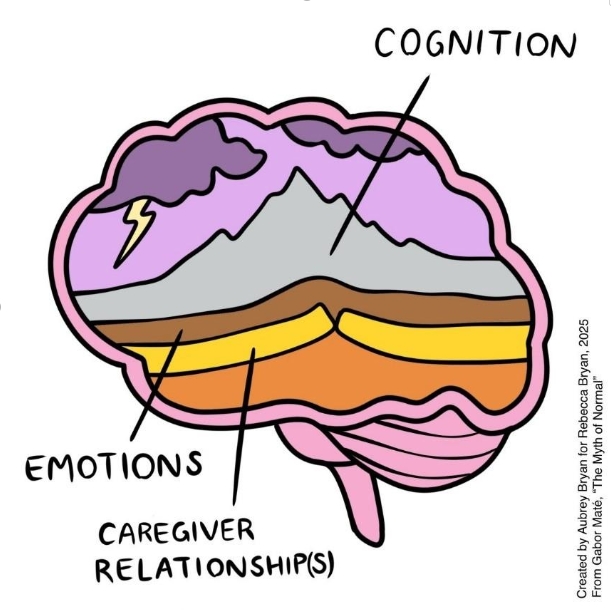
“If emotion is the ground of cognition, then relationships are the tectonic plates that shape the ground,” says Gabor Mate, physician and trauma informed expert in his book, The Myth of Normal. Society values rational, well-thought-out behavior. We need to realize that the parts of our brains responsible for rational thought - the very way we perceive the world and our experiences - is built on the emotional brain, and that caregiver relationships drive our earliest emotional experiences.
Supportive social relationships are critical to well-being in adulthood as well, not just for happiness but for physical health and longevity. Loneliness lowers immunity and increases the risk of chronic diseases like heart disease, stroke, diabetes, and dementia.
Knowing this, we recognize the flawed thinking in putting the onus of resilience onto the individual by defining resilience as grit, optimism, determination, and self-regulation. It’s not that these aren’t valuable but they underemphasize the value and necessity of relational health as the foundation of resilience. Therefore, to foster true resilience we must prioritize relational health:
Individually, by recognizing we have relationships with ourselves that we can strengthen through self-awareness, self-compassion and self-reflection
Interpersonally, by being intentional about connecting with others (including in-person interactions – our nervous systems are wired to be in proximity to others!)
Organizationally and in community, by creating cultures of trust, inclusion, and collaboration, recognizing that we form attachment relationships at work and in community as well as with family and friends.
How is your relational health? How and where do you connect with others? We’d love to hear from you, and hear what resources would help you with connection, at the New Jersey Office of Resilience: DCF.OfficeofResilience@dcf.nj.gov.

“If emotion is the ground of cognition, then relationships are the tectonic plates that shape the ground.” – Gabor Mate, MD
References
Center on the Developing Child, Harvard University, 2025. https://developingchild.harvard.edu/
Early Relational Health Implementation Guide (N.D.). American Academy of Pediatrics. https://downloads.aap.org/AAP/PDF/AAP%20ASHEW%20Implementation%20Guide.pdf?_gl=1*19v8kb4*_ga*MTUwNDE4MTg4Mi4xNzU5Nzc4NTMz*_ga_FD9D3XZVQQ*czE3NTk3Nzg1MzMkbzEkZzAkdDE3NTk3Nzg1MzMkajYwJGwwJGgw*_gcl_au*MTg3NTY3Mzc0OC4xNzU5Nzc4NTMy*_ga_GMZCQS1K47*czE3NTk3Nzg1MzMkbzEkZzAkdDE3NTk3Nzg1MzMkajYwJGwwJGgw
Healthy Outcomes from Positive Experiences, 2025. https://positiveexperience.org/
Holt-Lunstad, J. (2021). Loneliness and social isolation as risk factors: The power of social connection in prevention. Am J. Lifestyle Med, 15(5), 567-573. Doi: 10.1177/15598276211009454 https://pubmed.ncbi.nlm.nih.gov/34646109/
Mate, G. (2022). The Myth of Normal. New York, NY: Avery, an Imprint of Penguin Random House. https://drgabormate.com/book/the-myth-of-normal/
-
Science of Resilience
Share Science of Resilience on Facebook Share Science of Resilience on Twitter Share Science of Resilience on Linkedin Email Science of Resilience link
While adverse experiences can have a profound and lasting impact on health and well-being, they do not have to define an individual's future. The science of resilience shows us that the brain and body have a remarkable capacity for healing and adaptation.
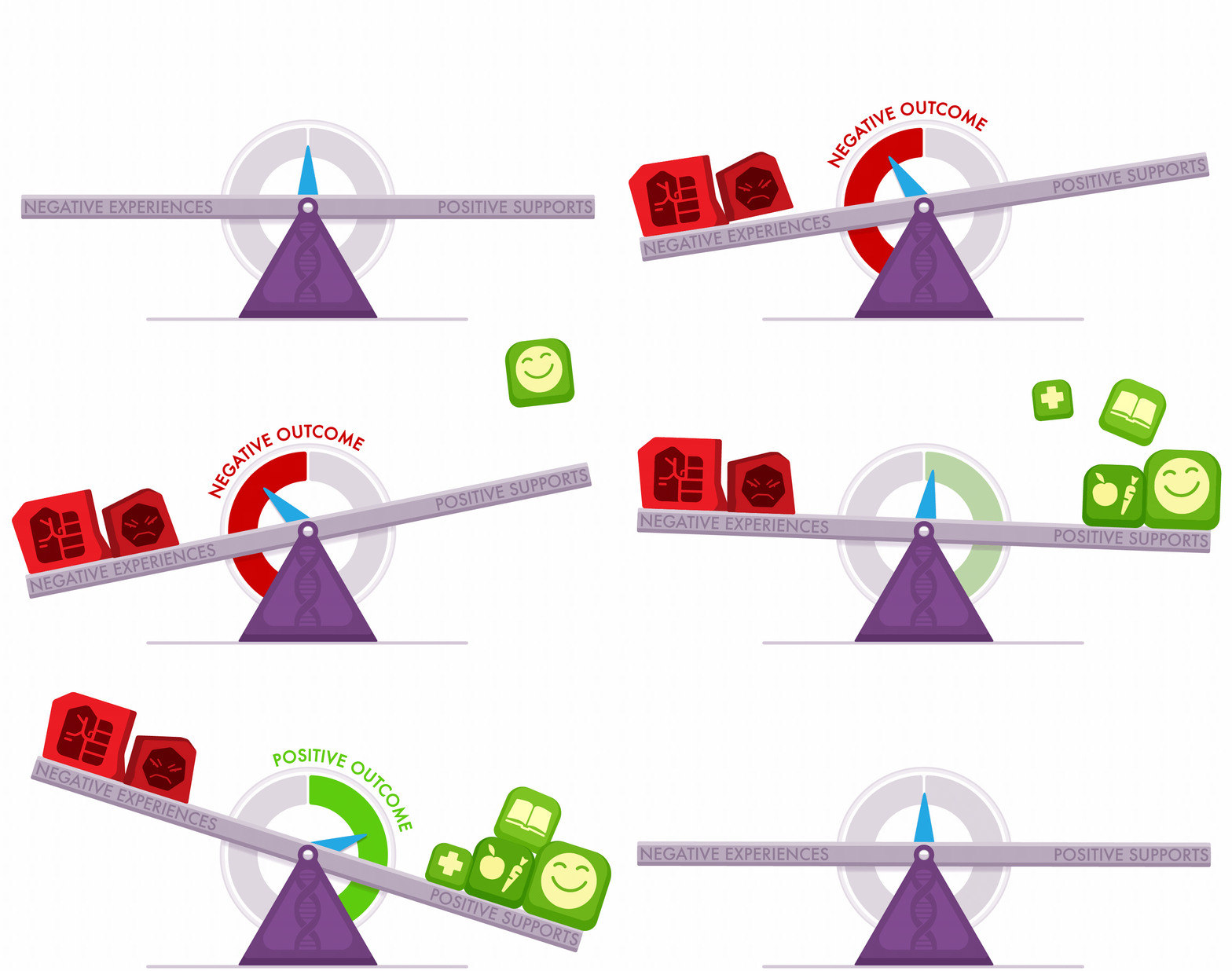
Resilience Scale » Alberta Family Wellness InitiativeRecent advancements in neuroscience and a growing body of research are actively cultivating resilience into trauma informed approaches. Concepts like neuroplasticity and neurogenesis demonstrate that the brain can create new neural pathways and cells throughout a person's life, offering a biological basis for recovery and growth.
This approach is universalContinue reading
While adverse experiences can have a profound and lasting impact on health and well-being, they do not have to define an individual's future. The science of resilience shows us that the brain and body have a remarkable capacity for healing and adaptation.
Resilience Scale » Alberta Family Wellness InitiativeRecent advancements in neuroscience and a growing body of research are actively cultivating resilience into trauma informed approaches. Concepts like neuroplasticity and neurogenesis demonstrate that the brain can create new neural pathways and cells throughout a person's life, offering a biological basis for recovery and growth.
This approach is universal, promoting whole-person care and empowering individuals to build a greater capacity for self-regulation and self-care.
InBrief: The Science of Resilience
Learn more in this two-minute video to visualize the science of resilience and understand how protective factors within a child’s developmental environment can help them build essential skills to cope with adversity.Watch this 7-minute video from the Alberta Family Wellness Initiative to learn more about the
Brain's Journey to Resilience. -
Research on Resilience
Share Research on Resilience on Facebook Share Research on Resilience on Twitter Share Research on Resilience on Linkedin Email Research on Resilience link

Time to Move Forward: Resilience and Trauma-Informed Care proposes that the term “Resilience and Trauma Informed Care” (RTIC) replace the term “Trauma Informed Care” (TIC). Leading with the term” resilience” rather than “trauma” has the potential to reorient providers’ attention to the resilience of individuals, families, and communities and not only to their trauma.
Action steps using ACEs and trauma-informed care: a resilience model discusses three key neuroscience concepts that are recommended for inclusion in Trauma-Informed Care programs and practices in ways that can enrich program design and guide the development of practical, resilience-oriented interventions that can be evaluatedContinue reading
Time to Move Forward: Resilience and Trauma-Informed Care proposes that the term “Resilience and Trauma Informed Care” (RTIC) replace the term “Trauma Informed Care” (TIC). Leading with the term” resilience” rather than “trauma” has the potential to reorient providers’ attention to the resilience of individuals, families, and communities and not only to their trauma.
Action steps using ACEs and trauma-informed care: a resilience model discusses three key neuroscience concepts that are recommended for inclusion in Trauma-Informed Care programs and practices in ways that can enrich program design and guide the development of practical, resilience-oriented interventions that can be evaluated for outcomes. A resilience-oriented approach to TIC is recommended that moves from trauma information to neuroscience-based action with practical skills to build greater capacity for self-regulation and self-care in both service providers and clients.
Latinx Families’ Strengths and Resilience Contribute to Their Well-being - Hispanic Research Center
This brief takes stock of—and presents findings from—the existing research on strengths and resilience within Latinx families. Based on the analysis of the literature, recommendations are provided to researchers for advancing strength-based research on Latino families and to programs and practitioners for building on strengths in service delivery.
The Office of Research and Child Well-Being’s Equity-Centered Strength-Focused Approach
The Office of Research and Child Well-Being (ORCW) crafted a program theory for well-being, well-becoming, and resiliency. ORCW’s unified theory is a pathway of how well-being, well-becoming, resiliency, and equity are all necessary components to the prosperity of a family, as well as how those concepts intersect.Resilience and mental health in children and adolescents
In order to promote optimal development of children and adolescents at risk for psychiatric disorders, a better understanding of the concept resilience is crucial. This review provides an overview of recent work on clinical and epidemiological correlates of resilience and mental health in children and adolescents.Role of adult hippocampal neurogenesis in stress resilience - ScienceDirect
This article explores whether there is a clear relationship between stress-induced changes in adult hippocampal neurogenesis, stress resilience and antidepressant-induced recovery from stress-induced changes in behaviour.Child Trends
Child Trends researchers analyze data about children and adolescents, their families, and other adults who support them to better understand the impacts of trauma and identify pathways to resilience in the face of adversity. Take a look at the latest research on trauma & resilience. -
Resilience Information for Families & Children
Share Resilience Information for Families & Children on Facebook Share Resilience Information for Families & Children on Twitter Share Resilience Information for Families & Children on Linkedin Email Resilience Information for Families & Children link
Image CaptionDiscover how protective factors within a child’s developmental environment can help build essential skills to help children cope with adversity and foster lifelong well-being.A Guide to Raising Resilient Children
Bounce Back Generation provides the 6 Building Blocks for Resilience. These 6 Building Blocks (Protection, Relationships, Coping Skills, Can-Do Attitude, Belonging, and Storytelling) helps us know what we need on a daily basis, remind us we are not alone in craving a more gentle and fulfilling existence, and encourage us to be brave enough to make changes that will lead to a more joyful and fulfilling life.
BounceContinue reading
Image CaptionDiscover how protective factors within a child’s developmental environment can help build essential skills to help children cope with adversity and foster lifelong well-being.A Guide to Raising Resilient Children
Bounce Back Generation provides the 6 Building Blocks for Resilience. These 6 Building Blocks (Protection, Relationships, Coping Skills, Can-Do Attitude, Belonging, and Storytelling) helps us know what we need on a daily basis, remind us we are not alone in craving a more gentle and fulfilling existence, and encourage us to be brave enough to make changes that will lead to a more joyful and fulfilling life.
Bounce Back Generation Shares 6 Building Blocks for Resilience | Support for FamiliesThe Center for the Study of Social Policy
Designed for caseworkers, this brief, part of the Strengthening Families curriculum, discusses the importance of how parents deal with stressors and manage stress through adversity—both personally and with relation to their child.
Designed for parents, this guide discusses how to strengthen families while building resilience in troubled times.A Guide to Resilience: Building young children’s capacity for resilience
A Guide to Resilience website provides resources to discover how protective factors within a child’s developmental environment can help build essential skills to help children cope with adversity and foster lifelong well-being.
This free graphic highlights Building Blocks for Resilience Ages 0-12 - Poster by Maggie Dent.The Center for Parent & Teen Communication shares information about Building Resilience in Teens: The 7 Cs.
Harvard Health shares strategies on Resilience: 5 ways to help children and teens learn it.
-
Tools for Resilience
Share Tools for Resilience on Facebook Share Tools for Resilience on Twitter Share Tools for Resilience on Linkedin Email Tools for Resilience linkTips-for-Optimizing-Resilience
This printable handout offers quick tips for optimizing resilience wherever you are.The Seven C's: The Essential Building Blocks of Resilience | Fostering Resilience
Offers simple questions for parents to ask themselves about how to model and fortify resilience in children.Expert-Tips-for-Resilience-Cards
You can print these eight cards to make your own resilience deck.Resilience Flyer
This flyer, from the NJ DCF Office of Resilience, is available in both English and Spanish, offers an at a glance definition of resilience as well as some resilience building skills.Social Wellness Checklist
The National Institutes of Health offers this three-page checklist with some tips for connecting with othersCultivating Well-Being: Well-Becoming and Resiliency
The Illinois Department of Children and Family Services shares a publicly available 56 page guidance document that provides definitions of well-being and well-becoming, with guiding principles for each. They describe resiliency theory, a framework for understanding how individuals, families, communities and systems can adapt, recover and even thrive in the face of adversity, challenges and significant life stressors.Building Staff Co-Regulation to Support Healthy Relationships in Youth
This 22-page guide is designed for project directors and practitioners providing relationship education for youth and young adults. It is intended to help programs integrate the science of self-regulation development into existing services through co-regulation, inspire programs to embed a co-regulation framework and strategies into their service delivery approach and share practical takeaways and lessons learned to help guide the integration of co-regulation into other programs.Tips-for-Optimizing-Resilience
This printable handout offers quick tips for optimizing resilience wherever you are.The Seven C's: The Essential Building Blocks of Resilience | Fostering Resilience
Offers simple questions for parents to ask themselves about how to model and fortify resilience in children.Expert-Tips-for-Resilience-Cards
You can print these eight cards to make your own resilience deck.Resilience Flyer
This flyer, from the NJ DCF Office of Resilience, is available in both English and Spanish, offers an at a glance definition of resilience as well as some resilience building skills.Social Wellness Checklist
The National Institutes of Health offers this three-page checklist with some tips for connecting with othersCultivating Well-Being: Well-Becoming and Resiliency
The Illinois Department of Children and Family Services shares a publicly available 56 page guidance document that provides definitions of well-being and well-becoming, with guiding principles for each. They describe resiliency theory, a framework for understanding how individuals, families, communities and systems can adapt, recover and even thrive in the face of adversity, challenges and significant life stressors.Building Staff Co-Regulation to Support Healthy Relationships in Youth
This 22-page guide is designed for project directors and practitioners providing relationship education for youth and young adults. It is intended to help programs integrate the science of self-regulation development into existing services through co-regulation, inspire programs to embed a co-regulation framework and strategies into their service delivery approach and share practical takeaways and lessons learned to help guide the integration of co-regulation into other programs.