

Lifelong Relational Health is the Foundation of Resilience
Newborns enter the world completely dependent upon their caregivers, not only for their physical needs of food, warmth, and protection, but for emotional needs as well. Born with only the foundation for the cerebral cortex present, a newborn’s brain makes one million connections every second for the first 3 years of life. This wiring is driven by moment-to-moment experiences in their daily lives, underscoring the critical need for safe and stable, nurturing relationships in safe and stable nurturing environments.
When newborns experience sustained adversity such as unpredictability and abuse, the brain wires survival responses more densely.
When newborns experience sustained neglect (lack of nurturing and/or basic needs), the brain slows its wiring.
When newborns experience “good enough” parenting/caregiving, the brain wires in a way that supports health and well-being.
The mutual responsiveness of adult-child relationships sets the foundation for all the learning, behavior and health that will occur in the future. This means that emotions experienced by the newborn, including the experience of calming down after upset (regulation), feeling safe and warm, and feeling seen and loved, turn on the genes that form the brain, with the emotional/intuitive structures of the brain growing first. These experiences form, and inform, a lifelong outlook, or worldview, as well.
“If emotion is the ground of cognition, then relationships are the tectonic plates that shape the ground,” says Gabor Mate, physician and trauma informed expert in his book, The Myth of Normal. Society values rational, well-thought-out behavior. We need to realize that the parts of our brains responsible for rational thought - the very way we perceive the world and our experiences - is built on the emotional brain, and that caregiver relationships drive our earliest emotional experiences.
Supportive social relationships are critical to well-being in adulthood as well, not just for happiness but for physical health and longevity. Loneliness lowers immunity and increases the risk of chronic diseases like heart disease, stroke, diabetes, and dementia.
Knowing this, we recognize the flawed thinking in putting the onus of resilience onto the individual by defining resilience as grit, optimism, determination, and self-regulation. It’s not that these aren’t valuable but they underemphasize the value and necessity of relational health as the foundation of resilience. Therefore, to foster true resilience we must prioritize relational health:
Individually, by recognizing we have relationships with ourselves that we can strengthen through self-awareness, self-compassion and self-reflection
Interpersonally, by being intentional about connecting with others (including in-person interactions – our nervous systems are wired to be in proximity to others!)
Organizationally and in community, by creating cultures of trust, inclusion, and collaboration, recognizing that we form attachment relationships at work and in community as well as with family and friends.
How is your relational health? How and where do you connect with others? We’d love to hear from you, and hear what resources would help you with connection, at the New Jersey Office of Resilience: DCF.OfficeofResilience@dcf.nj.gov.
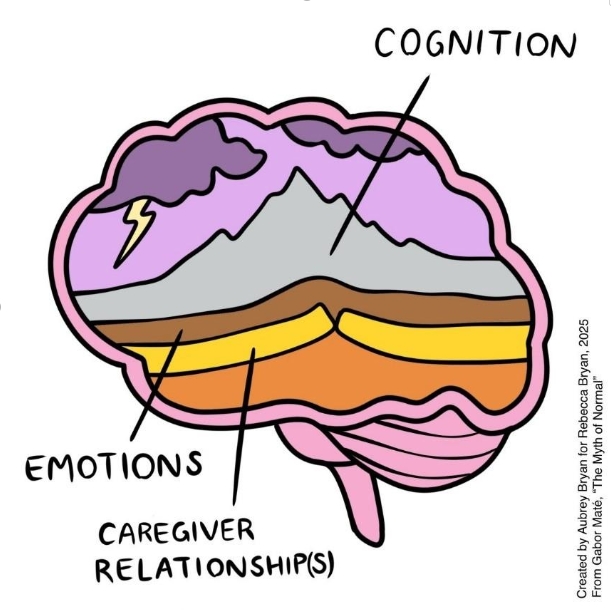
“If emotion is the ground of cognition, then relationships are the tectonic plates that shape the ground.” – Gabor Mate, MD
References
Center on the Developing Child, Harvard University, 2025. https://developingchild.harvard.edu/
Early Relational Health Implementation Guide (N.D.). American Academy of Pediatrics. https://downloads.aap.org/AAP/PDF/AAP%20ASHEW%20Implementation%20Guide.pdf?_gl=1*19v8kb4*_ga*MTUwNDE4MTg4Mi4xNzU5Nzc4NTMz*_ga_FD9D3XZVQQ*czE3NTk3Nzg1MzMkbzEkZzAkdDE3NTk3Nzg1MzMkajYwJGwwJGgw*_gcl_au*MTg3NTY3Mzc0OC4xNzU5Nzc4NTMy*_ga_GMZCQS1K47*czE3NTk3Nzg1MzMkbzEkZzAkdDE3NTk3Nzg1MzMkajYwJGwwJGgw
Healthy Outcomes from Positive Experiences, 2025. https://positiveexperience.org/
Holt-Lunstad, J. (2021). Loneliness and social isolation as risk factors: The power of social connection in prevention. Am J. Lifestyle Med, 15(5), 567-573. Doi: 10.1177/15598276211009454 https://pubmed.ncbi.nlm.nih.gov/34646109/
Mate, G. (2022). The Myth of Normal. New York, NY: Avery, an Imprint of Penguin Random House. https://drgabormate.com/book/the-myth-of-normal/

Thank you for your contribution!
Help us reach out to more people in the community
Share this with family and friends