Share Understanding Trauma-Informed Approaches on FacebookShare Understanding Trauma-Informed Approaches on X (formerly Twitter)Share Understanding Trauma-Informed Approaches on LinkedinEmail Understanding Trauma-Informed Approaches link
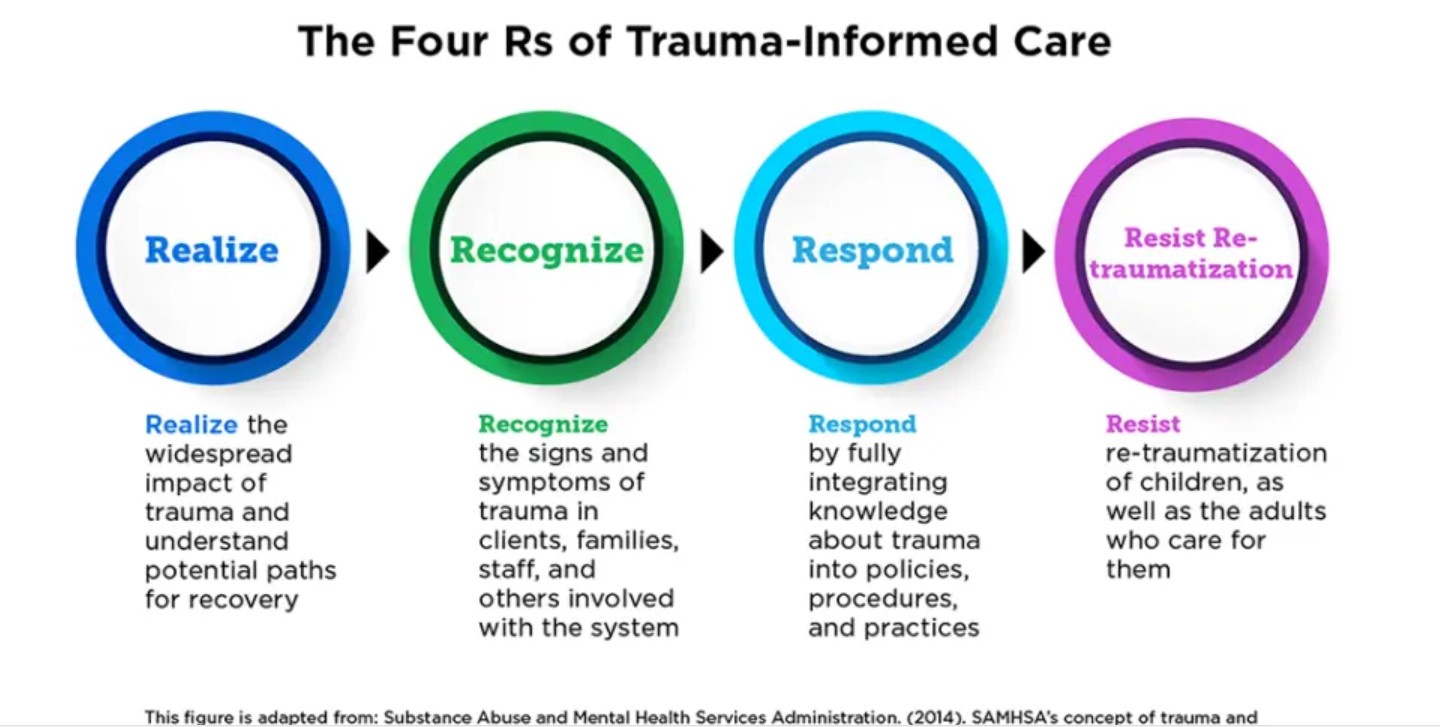
Trauma-informed approaches involve understanding, recognizing, and responding to the effects of all types of trauma. A trauma-informed organization prioritizes and adapts:
A trauma-informed approach is essential for organizations aimingContinue reading
Trauma-informed approaches involve understanding, recognizing, and responding to the effects of all types of trauma. A trauma-informed organization prioritizes and adapts:
A trauma-informed approach is essential for organizations aiming to support individuals who have experienced trauma. The Substance Abuse and Mental Health Services Administration (SAMHSA) outlines ten key domains that provide a framework for embedding trauma-awareness and sensitivity within organizational practices. By focusing on these domains, organizations can create environments that promote healing and resilience, ensuring that trauma-informed care becomes a foundational aspect of their mission and operations. Below is the list of domains that guide the implementation of this approach. You can learn more about each domain by viewing the linked webinars.
Share Trauma Informed Resources & Tools for Organizations on FacebookShare Trauma Informed Resources & Tools for Organizations on X (formerly Twitter)Share Trauma Informed Resources & Tools for Organizations on LinkedinEmail Trauma Informed Resources & Tools for Organizations link
Center for Trauma-Informed Policy and Practice (CTIPP) This CTIPP toolkit provides educational concepts and practical strategies to support team members (I.E., defined in the toolkit as employees, staff, workers, interns, fellows, leadership, human resources and administrative professionals, volunteers, committee and board members, etc.) in advocating for more trauma-informed workplacesTheirCommunity Advocacy Network is a national grassroots advocacy and policymaking campaign committed to healing and resilience.
Substance Abuse and Mental Health Services Administration (SAMHSA) Explore SAMHSA's comprehensive guide on implementing trauma-informed approaches. This guide offers a detailed framework to help organizations integrate trauma-sensitiveContinue reading
Center for Trauma-Informed Policy and Practice (CTIPP) This CTIPP toolkit provides educational concepts and practical strategies to support team members (I.E., defined in the toolkit as employees, staff, workers, interns, fellows, leadership, human resources and administrative professionals, volunteers, committee and board members, etc.) in advocating for more trauma-informed workplacesTheirCommunity Advocacy Network is a national grassroots advocacy and policymaking campaign committed to healing and resilience.
Substance Abuse and Mental Health Services Administration (SAMHSA) Explore SAMHSA's comprehensive guide on implementing trauma-informed approaches. This guide offers a detailed framework to help organizations integrate trauma-sensitive practices into their operations, ensuring a supportive environment for everyone.SAMHSA Practical Guide for Trauma Informed Approachesbuilds on SAMHSA’s 2014 SAMHSA Concept for Trauma Informed Care and TIP 57: Trauma-Informed Care in Behavioral Health Services. Its primary goals are to provide implementation strategies across multiple domains—from governance to staff training to evaluation—and to encourage leadership to adopt a TIA at the organizational levels.Thistwo pageinfographicprovides information on the 10 implementation domains and 6 principles of trauma informed approaches.
Center for Health Care Strategies Thiswebsite, developed by the Center for Health Care Strategies, provides resources from trauma-informed care leaders across the country to help improve patient outcomes, increase patient and staff resilience, and reduce avoidable health care service use and costs. While geared toward health care, many of these lessons from this website can be applied elsewhere, including social services and education.
Trauma Informed Oregon Trauma Informed Oregon serves as a centralized source of information and resources for trauma informed efforts. Access learning resources, knowledge and capacity building and tool kits. They provide a Road Map outlininga number ofcommon steps that organizations move through in a developmental way. The Trauma Informed Care Screening Tool builds on the Road Map by delving into each phase and offering a series of developmental actions; these tools go hand in hand.
The Traumatic Stress Institute The Traumatic Stress Institute(TSI) of Klingberg Family Centers promotes excellence in trauma-informed services to organizations nationally and internationally who treat clients with histories of psychological trauma and attachment disruptions. Their Risking Connection Change Model (formerly named the Whole-System Change Model) is the result of TSI’s years of experience working with clients to create lasting change. TSI serves as a steady, long-term partner supporting systems as they prepare to launch, implement, and sustain TIC culture and practices.
Project Echo The mission at Project Echo is to educate families, communities and professionals about trauma and resilience in order to promote survivor empowerment, resolve individual and community-level trauma, and create the safe, stable, nurturing relationships that break the cycle of generational trauma. [Access their free infographics]
The Office for Victims of Crime The Vicarious Trauma Toolkit (VTT) was developed on the premise that exposure to the traumatic experiences of other people—known as vicarious trauma.The VTT includes tools and resources tailored specifically to these fields that provide the knowledge and skills necessary for organizations to address the vicarious trauma needs of their staff. To begin exploring the VTT, select one of the disciplines below and visit the comprehensive Compendium of Resources.
The TRIADS Framework The TRIADS Framework(Trauma and Resilience-informed Inquiry for Adversity, Distress, and Strengths) describes an evidence-informed approach for screening, provider response, and patient education about Adverse Childhood Experiences (ACES) in healthcare settings. They offer free training and scenarios that illustrate ACEs screening using the TRIADS framework in clinical encounters between health care team members and patients and families.
The Child and Adolescent Health Measurement The Child and Adolescent Health Measurement Initiative (CAHMI) offers a library of resources(External link) related to their work to improve child and family health and well-being. Resources, summaries of projects, toolkits, research papers and reports, issue briefs, presentations, are available on their site.
Share Frameworks on Trauma Informed Approaches on FacebookShare Frameworks on Trauma Informed Approaches on X (formerly Twitter)Share Frameworks on Trauma Informed Approaches on LinkedinEmail Frameworks on Trauma Informed Approaches link
The Missouri Model: A Developmental Framework for Trauma-Informed Approaches | dmh.mo.gov This document was developed by a group of organizations in the state of Missouri who have been active champions in addressing the impact of trauma and working towards becoming trauma informed organizations. They represent a variety of organizations that serve children, youth, families and/or adults in a variety of settings including healthcare, inpatient psychiatric, substance abuse, and community based mental health services.
The Missouri Model: A Developmental Framework for Trauma-Informed Approaches | dmh.mo.gov This document was developed by a group of organizations in the state of Missouri who have been active champions in addressing the impact of trauma and working towards becoming trauma informed organizations. They represent a variety of organizations that serve children, youth, families and/or adults in a variety of settings including healthcare, inpatient psychiatric, substance abuse, and community based mental health services.
Road Map to Trauma Informed Care • Trauma Informed Oregon Trauma Informed Oregon (TIO) is a collaboration of university, public and private partners, individuals with lived experience, youth and family members that are committed to creating and sustaining a trauma informed system of care in Oregon. Check out the TIO Road Map to TIC, which offers phases to the implementation process. Each phase contains a marker(s) along the road that is integral to implementing that phase. When clicking on the road or phase sign, a hover box provides a description of that phase and leads you to the steps, actions, and resources that are helpful for implementation.
TIC Wisconsin Model The Wisconsin Continuum of Trauma-Informed Care is a comprehensive framework that outlines the steps and principles necessary to implement trauma-informed practices within various settings. It emphasizes the importance of trauma awareness, sensitivity, and responsiveness across all levels of an organization, including leadership, policies, procedures, and the physical environment. The continuum begins with trauma awareness and progresses through actions that are trauma sensitive and responsive.
TOOLKIT: Trauma-Informed Workplaces The Campaign for Trauma-Informed Policy and Practice (CTIPP) toolkit provides comprehensive guidance on integrating trauma-informed policies and practices across all workplace levels. From leading with empathy to fostering transparency, readers will discover evidence-based organizational strategies alongside practical individual approaches to self-awareness and boundary-setting.
Share Trauma Informed Schools on FacebookShare Trauma Informed Schools on X (formerly Twitter)Share Trauma Informed Schools on LinkedinEmail Trauma Informed Schools link
The Center for Safe and Resilient Schools have supported communities across the United States and around the world before, during, and after crises. Launched by leading experts in the field of trauma-informed schools, The Center has pioneered national practices for threat assessment, crisis response, and trauma-responsive strategies.
Healing Schools Project Healing Schools Project is aimed at ending the teacher retention crisis—creating schools where educators feel valued, supported, and committed to staying. They create a safe environment for teachers and leaders to talk about their experiences, and address potential barriers that may be preventing teachers from staying in the profession. Check out their free resources for educator wellness.
Resilient Futures Resilient Futures is a nonprofit founded in 2018 to promote well-being and healing through trauma-informed practices. They partner with communities to address the widespread impact of trauma using evidence-based strategies rooted in the principles of trauma-informed care. The offer free resources for educators to help understand trauma and foster healing, creating safe spaces for themselves and their students.
Trauma-Informed & Healing-Centered Practices The New Jersey Department of Educationshares resources to support schools in creating Trauma-Informed & Healing-Centered Practices. Learn how schools have the opportunity toestablish supportive, positive learning environments and practices for all students that not only provide structure but are also safe, welcoming, and relationship-centered.
Interview: The Need for Trauma-Informed Schools Article on the need for trauma-informed schools interview features Q&As with both professionals and users of the mental health system on topics of special interest to parents and families. They are designed to provide a closer look at new research, trends, and people.
The Center for Safe and Resilient Schools have supported communities across the United States and around the world before, during, and after crises. Launched by leading experts in the field of trauma-informed schools, The Center has pioneered national practices for threat assessment, crisis response, and trauma-responsive strategies.
Healing Schools Project Healing Schools Project is aimed at ending the teacher retention crisis—creating schools where educators feel valued, supported, and committed to staying. They create a safe environment for teachers and leaders to talk about their experiences, and address potential barriers that may be preventing teachers from staying in the profession. Check out their free resources for educator wellness.
Resilient Futures Resilient Futures is a nonprofit founded in 2018 to promote well-being and healing through trauma-informed practices. They partner with communities to address the widespread impact of trauma using evidence-based strategies rooted in the principles of trauma-informed care. The offer free resources for educators to help understand trauma and foster healing, creating safe spaces for themselves and their students.
Trauma-Informed & Healing-Centered Practices The New Jersey Department of Educationshares resources to support schools in creating Trauma-Informed & Healing-Centered Practices. Learn how schools have the opportunity toestablish supportive, positive learning environments and practices for all students that not only provide structure but are also safe, welcoming, and relationship-centered.
Interview: The Need for Trauma-Informed Schools Article on the need for trauma-informed schools interview features Q&As with both professionals and users of the mental health system on topics of special interest to parents and families. They are designed to provide a closer look at new research, trends, and people.


 Center for Trauma-Informed Policy and Practice (CTIPP)
  The Missouri Model: A Developmental Framework for Trauma-Informed Approaches | dmh.mo.gov